Scan to CAD Conversion Services: The New Standard in Smart Construction
Smart construction isn’t just about automation, AI, or futuristic job sites. At its core, it’s about accurate data, intelligent planning, and seamless collaboration and that’s exactly why scan to CAD conversion services are no longer a “nice-to-have,” but a growing industry standard.
Across the UK, USA, and global construction markets, project teams are facing mounting pressure: tighter timelines, rising material costs, stricter compliance, and increasing demand for retrofit and renovation projects. In this environment, relying on outdated drawings or manual measurements simply doesn’t cut it anymore.
Instead, construction leaders are turning to laser scans, point clouds, and precise CAD models to create a single source of truth for design, planning, and execution.
So, why is scan to CAD becoming such a critical part of modern construction workflows? Let’s break it down.
What Is Scan to CAD Conversion in Simple Terms?
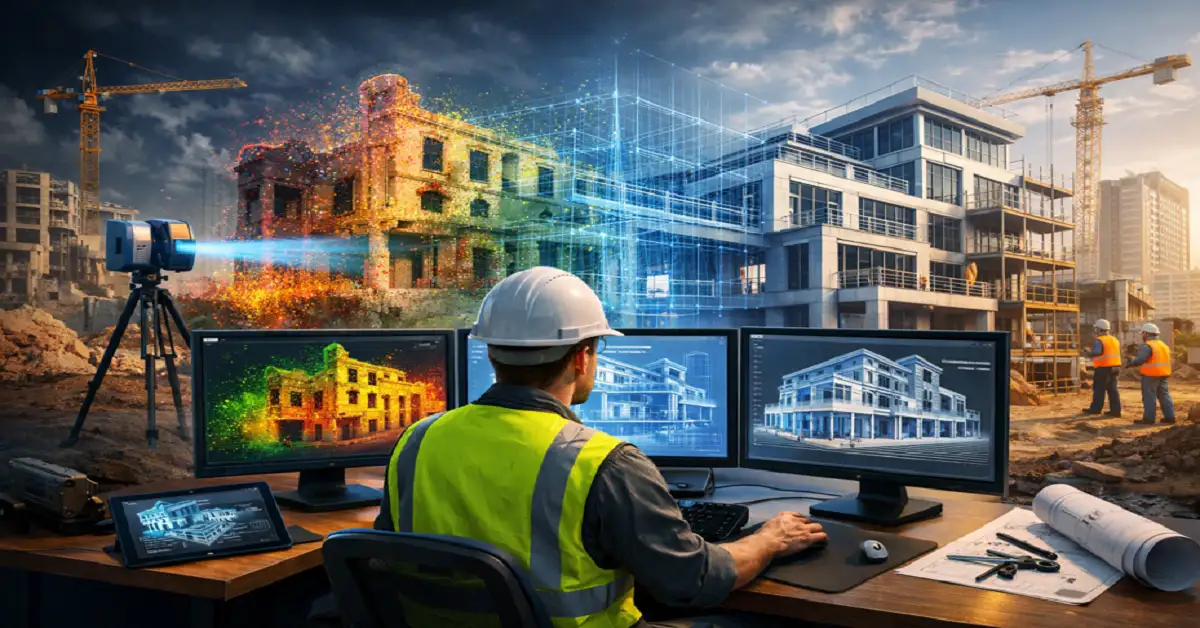
Scan to CAD conversion is the process of transforming laser-scanned data or point cloud files into accurate 2D drawings or 3D CAD models.
These scans are typically captured using:
- LiDAR scanners
- 3D laser scanning equipment
- Photogrammetry tools
The raw scan data is then converted into:
- Floor plans
- Elevations
- Sections
- Detailed 3D CAD or BIM-ready models
This approach eliminates guesswork and gives architects, engineers, and contractors a true-to-life digital representation of existing conditions.
Why Are Traditional Construction Drawings No Longer Reliable?
If you’ve ever worked on a renovation or refurbishment project, you already know the answer.
Traditional drawings often suffer from:
- Missing updates
- Inaccurate dimensions
- On-site modifications never recorded
- Legacy files created decades ago
According to data from McKinsey, poor data and rework contribute to up to 30% cost overruns on construction projects.
Scan to CAD conversion services address this problem by ensuring:
- What’s designed is exactly what exists
- Everyone works from the same accurate dataset
- Costly surprises are identified early
How Does Scan to CAD Support Smart Construction Practices?
Smart construction relies on data-driven decisions, and scan-based CAD models provide exactly that.
Here’s how scan to CAD fits into the smart construction ecosystem:
- Creates accurate as-built documentation
- Enables clash detection before construction begins
- Supports BIM integration and digital twins
- Improves coordination between trades
- Reduces rework and RFIs
In short, it transforms physical spaces into intelligent digital assets.
Why Is Scan to CAD Essential for Renovation and Retrofit Projects?
In the UK and USA, a significant portion of construction activity now focuses on renovation, refurbishment, and adaptive reuse.
According to the UK Green Building Council, retrofitting existing buildings is essential to meet net-zero targets.
Scan to CAD conversion services are particularly valuable because:
- Existing buildings rarely match old drawings
- Structural changes accumulate over time
- Accurate geometry is essential for energy modeling and compliance
For retrofit projects, scan to CAD isn’t optional, it’s foundational.
What Role Do 3D CAD Conversion Services Play in Modern Construction?
While 2D drawings are still useful, the industry is rapidly moving toward 3D workflows.
3D CAD conversion services allow teams to:
- Visualize complex structures before construction
- Detect clashes between MEP, structural, and architectural elements
- Support BIM coordination and simulation
- Improve client communication and approvals
A Dodge Data & Analytics report found that BIM and 3D modeling can reduce errors by up to 61%.
When scan data is converted into precise 3D CAD models, the benefits multiply across the entire project lifecycle.
Why Are CAD Conversion Services in USA and UK Seeing Rapid Growth?
The demand for CAD conversion services in USA and UK markets is accelerating due to several converging trends:
1. Aging Infrastructure
Many commercial and public buildings were constructed decades ago with incomplete or outdated documentation.
2. Strict Compliance Requirements
UK Building Regulations and US codes demand higher accuracy and accountability than ever before.
3. Labor Shortages
With fewer skilled drafters and surveyors available, automation-backed scan workflows fill the gap.
4. Digital Transformation Initiatives
Both regions are heavily investing in digital construction, BIM mandates, and smart city development.
These factors are pushing scan to CAD from a specialist service into a mainstream construction requirement.
How Do Customized CAD Conversion Services Add Real Value?
Not every project needs the same level of detail and that’s where customized CAD conversion services shine.
Customization allows project teams to:
- Define specific Levels of Detail (LOD)
- Focus only on relevant systems or spaces
- Align drawings with downstream BIM or fabrication needs
- Control costs without sacrificing accuracy
For example:
- A facility manager may need simplified floor plans
- A structural engineer may require precise beam geometry
- An MEP contractor may need detailed service routing
Customization ensures CAD outputs are fit-for-purpose, not over-engineered.
What Challenges Do Companies Face When Adopting Scan to CAD?
Despite its advantages, scan to CAD adoption comes with challenges:
- Managing large point cloud datasets
- Ensuring interoperability between software platforms
- Maintaining accuracy during conversion
- Aligning scanning outputs with design standards
This is why many firms partner with experienced providers offering:
- Advanced quality control workflows
- Industry-standard CAD and BIM expertise
- Clear communication between scan and design teams
The right process turns complexity into clarity.
Is Scan to CAD Cost-Effective for Construction Projects?
At first glance, scan to CAD may seem like an added expense. In reality, it’s a cost-saving investment.
Benefits include:
- Reduced rework
- Fewer site visits
- Faster approvals
- Lower change order risks
According to Autodesk, accurate as-built data can reduce project costs by up to 20% over the lifecycle.
When measured against avoided delays and errors, scan to CAD pays for itself quickly.
How Does Scan to CAD Improve Collaboration Across Teams?
One of the biggest advantages of scan to CAD conversion services is improved collaboration.
With accurate digital models:
- Architects design with confidence
- Engineers coordinate systems seamlessly
- Contractors plan installations precisely
- Clients understand scope visually
This shared clarity reduces friction and keeps projects moving forward.
What Does the Future Look Like for Scan to CAD in Smart Construction?
The future is only getting smarter.
Emerging trends include:
- AI-assisted point cloud processing
- Automated feature recognition
- Integration with digital twins
- Real-time updates from site scans
As construction continues its digital evolution, scan to CAD will become as fundamental as CAD drafting itself.
Final Thoughts
Scan to CAD conversion services are redefining how the construction industry approaches accuracy, efficiency, and collaboration.
For business owners, architects, engineers, and tech decision-makers in the UK, USA, and beyond, the message is clear:
- Smart construction starts with smart data
- Accurate digital foundations lead to better outcomes
- Scan to CAD is becoming the industry baseline not the exception
As more firms adopt digital-first workflows, partnering with an experienced UK-based CAD design company that understands global standards can make the transition smoother and more impactful without disrupting existing processes.
In a world where precision drives performance, scan to CAD is no longer just a service.
It’s a strategic advantage.
FAQs
1. What are scan to CAD conversion services in construction?
Scan to CAD conversion services involve converting laser scan or point cloud data into accurate 2D drawings or 3D CAD models. These services help architects, engineers, and contractors work with precise as-built documentation, reducing errors and rework in construction projects.
2. Why is scan to CAD important for smart construction projects?
Scan to CAD is essential for smart construction because it provides reliable digital data for planning, coordination, and decision-making. Accurate CAD models support BIM workflows, clash detection, and automation, which are core elements of modern smart construction practices.
3. How do scan to CAD services help renovation and retrofit projects in the UK and USA?
In renovation and retrofit projects, existing buildings often differ from old drawings. Scan to CAD conversion services capture real-world conditions accurately, helping UK and US construction teams avoid unexpected design conflicts, delays, and compliance issues.
4. What is the difference between 2D and 3D CAD conversion services?
2D CAD conversion services produce floor plans, sections, and elevations, while 3D CAD conversion services create detailed three-dimensional models. 3D models improve visualization, coordination, and BIM integration, making them ideal for complex or large-scale construction projects.
5. Are scan to CAD conversion services cost-effective?
Yes, scan to CAD conversion services are cost-effective in the long run. They reduce rework, minimize site errors, and lower change orders. Accurate as-built data helps construction teams save both time and money throughout the project lifecycle.
6. Why are CAD conversion services in USA and UK growing so fast?
CAD conversion services in USA and UK are growing due to aging infrastructure, strict building regulations, labor shortages, and increased adoption of digital construction technologies. These factors make accurate and efficient digital documentation more important than ever.
7. When should businesses choose customized CAD conversion services?
Businesses should choose customized CAD conversion services when they need specific levels of detail, industry-specific drawings, or project-based outputs. Customization ensures CAD files align perfectly with design, construction, or facility management requirements.